Museum AI Pledge: Keeping Human Expertise at the Center
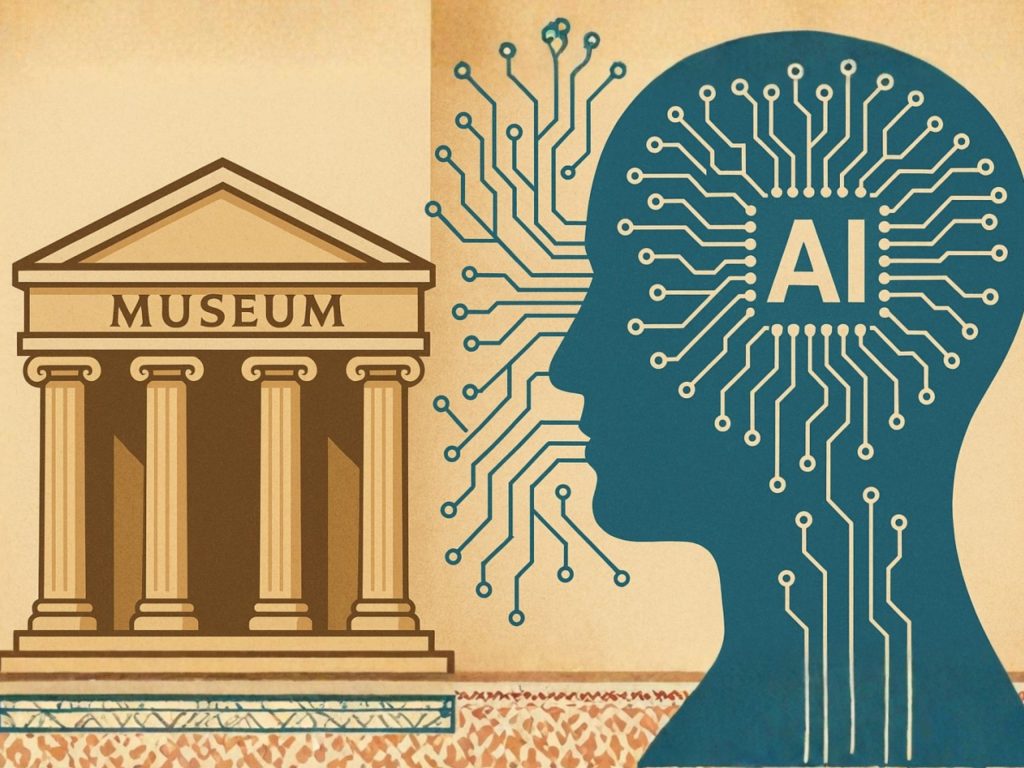
Written by Marion Carré and Adam Rozan. Originally published on my Linkedin on November 19, 2025.
We live in an AI-infused world, where AI is knowingly or unknowingly part of our everyday lives and work, and, in many ways, we are only at the beginning. Today’s organizations and industries understand this and are responding in kind, with a mix of training, policies, and even usage applications. Museums are included in this mix, and many institutions have already established AI-based policies and training programs. In contrast, others have experimented with and continue to experiment with AI for their internal and external-facing work. Yet, it’s fair to say that museums are not fully AI-integrated.
As is often said, quoted, and cited, “the public continues to view museums as highly trustworthy,” a data point that has been annually tested, confirmed, and studied by the American Alliance of Museums; and this is not just within the U.S., it’s international too. The trust bestowed on museums is the source of our strength. It provides the cultural community with the rationale, encouragement, and motivation to learn, continue understanding AI, its current and potential uses, and, importantly, where possible, lead in AI. Specifically in the areas of public transparency and usage. By that, we mean, what and how are museums and the cultural sector using AI? What functions and activities are now being performed by AI, or with AI support, to supplement staff, contractors, and volunteers? What, when, and where would the public encounter or experience AI content, whether whole, partial, or assisted?
These are new questions and considerations, each warranting additional time and careful discussion; this includes the implications of when, where, and how we use AI — and when we don’t—and how, as an organization, not just as individuals, we decide to use AI or not.
Artificial intelligence is already part of our daily tools and practices. From writing assistants to image editors, from search engines to data analytics, AI is now woven into the way we work, communicate, and create. Museums, like all cultural institutions, are no exception.
Rather than denying or fearing this transformation, we believe it is our responsibility to embrace AI consciously and responsibly — to ensure that it strengthens, rather than weakens, our human values and our public mission.
Table of Contents
1. Affirming the human at the core
We commit to keeping people — their creativity, judgment, and ethics — at the center of museum- and culture-based work, and to ensuring they remain in the loop and responsible whenever AI is used.
AI can support our work, but it cannot replace the professional intent and specialized knowledge that give culture meaning. Our exhibitions, programs, and communications will continue to reflect expert perspectives and critical thinking built through years of training and practice.
Museums exist to transmit human knowledge, memory, and interpretation. AI must serve our professional objectives. We are committed to maintaining clear professional direction: defining goals, questions, and intentions first — then selecting and shaping AI tools to support that vision.
2. Supporting our teams
We commit to training and accompanying museum professionals in understanding and using AI tools responsibly.
By helping staff to experiment, question, and evaluate AI, we strengthen their capacity to innovate while remaining faithful to the institution’s values.
Like any tool, AI requires a basic level of understanding so museum professionals can actively manage and direct its use, rather than becoming passive ‘user-consumers’ who overlook its inherent strengths and weaknesses.
Without a basic understanding of AI, two extremes are possible. Completely dismissing AI as a tool can lead to algorithmic aversion and mistrust in technology, preventing staff from benefiting from its strengths. On the other hand, blind trust can result in algorithmic loafing, encouraging people to accept its outputs without question and risk perpetuating its errors.
3. Being transparent and open
We commit to explaining how AI is used in our work — when it matters, and in ways that are meaningful and easy to understand.
Transparency is not about proving that our work is “human enough” but about building trust through openness: showing that we use AI thoughtfully, ethically, and in the service of knowledge sharing, always guided by professional standards.
We believe AI should support understanding, not blur it. When we use AI tools to create, interpret, or communicate, we will ensure that technology respects the origins, context, and intentions behind the works and ideas we engage with. This means being attentive to how AI systems are trained, what sources they draw from, and whether they honor the cultural and historical depth that museum work requires.
4. Encouraging collective reflection
We believe museums can play a vital role in helping society understand AI.
Through our programs, exhibitions, and communication, we aim to foster a broader public conversation on how technology influences creativity, knowledge, and identity. Audiences should be involved in it.
We recognize that AI is now everywhere, and the goal is not to push back against it but to guide its responsible adoption, helping audiences and professionals alike develop new perspectives on it. Museums can become spaces where visitors not only consume content but also question, experiment with, and co-create alongside AI. We will create exhibitions and programs that encourage the public to explore AI’s possibilities and limitations — fostering curiosity, critical thinking, and agency.
5. Valuing process over speed
We commit to building friction into our use of AI — not as inefficiency, but as a space for reflection, depth, and meaning-making.
Museums are not factories for content. We are guardians of memory, facilitators of dialogue, and spaces for contemplation. Speed and efficiency must never come at the cost of the slow, deliberate work that gives our mission its power.
Moments of constraint, pause, attention, and limitation are vital to depth and meaning. We will resist the pressure to optimize everything. Instead, we will design moments that constrain us and make us think — whether that means longer exhibition development cycles, collaborative curatorial processes, or programs that invite visitors to pause, question, and dwell.
6. Protecting the whole creative ecosystem
We commit to designing AI practices with awareness of their systemic impacts — on labor, culture, education, equity, and the communities we serve.
AI is not neutral. It reshapes who gets to tell stories, whose knowledge is valued, and how cultural memory is transmitted. We will not treat AI as a “bolt-on feature” but will consider its effects holistically from the beginning, ensuring it serves the public good.
For museums, this means:
- Labor: Ensuring AI augments rather than displaces museum workers; investing in upskilling and new roles rather than cost-cutting. We recognize that creative labor is increasingly precarious, and AI must not compound this instability.
- Equity: Interrogating whose voices, stories, and cultures are represented (or erased) in AI training data; actively working to counter bias
- Sustainability: Considering the environmental cost of AI infrastructure and prioritizing tools that align with ecological responsibility
7. Embracing experimentation and discovery
We commit to encouraging professional experimentation and exploration in our use of AI.
Museums are places of wonder and discovery, driven by thorough inquiry. AI’s ability to surprise us — to create unexpected connections, uncover hidden patterns, or generate outputs that challenge our assumptions — can be a valuable tool for professional exploration when used with proper methodology and careful oversight.
We will explore which stages of museum work gain the most from human–AI collaboration. This involves designing experimentation not as a closed process, but as an open one that includes public feedback from the beginning. Instead of relying only on professional expertise, we will create environments where museum professionals, together with collaborators and communities, can test new approaches, observe how visitors interact with them, and determine whether these approaches truly meet their needs.
We recognize that innovation requires space for trial and learning. We will support our teams in exploring AI’s potential while maintaining the professional standards and intellectual rigor that define museum practice.
Our Commitment
This pledge is a living document. As AI evolves, so too will our understanding of its role in museum work. We commit to revisiting these principles regularly, learning from our community, and adapting our practices in response to new challenges and opportunities.
We invite professionals in museums, cultural institutions, and heritage organizations to join us in this commitment — not as a final answer, but as a starting point for collective action.
Together, we can ensure that AI serves humanity’s deepest need: to create meaning, preserve memory, and imagine new futures — always with care, always with intention, always in dialogue with the past.
AI Disclosure: Please note that this article was written with AI assistance during the research and editing phases of the writing.
Explore More
If you found this piece on museums and AI thought-provoking, you might also enjoy these related explorations:
- Being Social: What Museums Need to Understand for the Future – A deeper dive into how museums can navigate digital and social engagement
- Top 5 Reasons Why Museums Close – Understanding the sustainability challenges museums face
- What Can Pokemon Go Mean for Museums? – How digital gaming and technology can attract new audiences
- The Mythological Museum Visitor: The Young Cosmopolitan – Examining who our audiences really are