
Like you, I’m trying to become as knowledgeable and conversant about AI as possible, and to gain as much experience with it as I can. Yes, I have concerns. Yes, I use AI. Yes, I used AI for this introduction. And yes, I believe AI is one of the most important technologies and significant changes we are facing, with the potential for enormous good, but also real threats and consequences for the arts, museums, and really, just about everything.
I often have these same conversations with my friend Cory Garfin, an audience research expert who is now focused on helping nonprofits make sense of AI, what it can do, what it can’t, and where it can actually be useful. I caught up with Cory to learn more about what he’s working on and thinking about now.
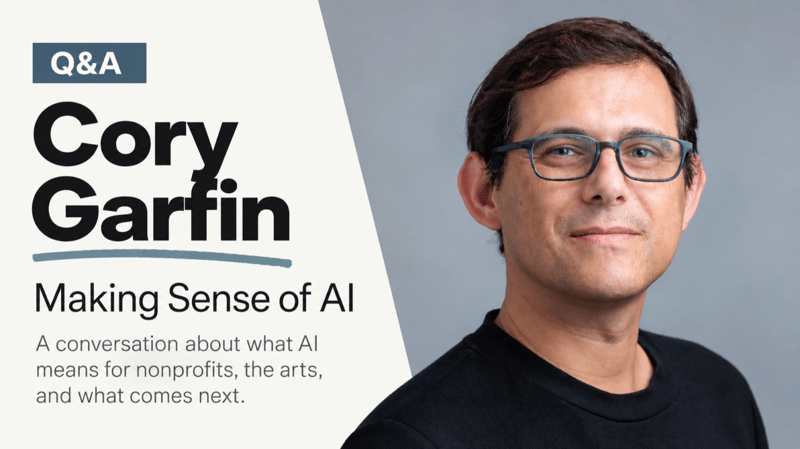
Adam Rozan: Cory, hello. Can you introduce yourself and share what you do?
Cory Garfin: I'm Cory Garfin, a consultant for cultural and other mission-driven organizations, currently focused on helping them make sense of AI and how to use it to their advantage. That work happens at a few levels: "AI 101" workshops and webinars, custom tools built for individual organizations, and capacity building so teams can eventually do this themselves. I do much of it with Devon VanHouten-Maldonado, Executive Director of the Chicago youth arts organization SkyART, through an agency we co-founded called SCL CPTL ("social capital").
Prior to this, I spent almost a decade in audience research and evaluation for arts and cultural organizations, most recently as Co-Director of Slover Linett at NORC. Those were formative years for me, and everything I do is still grounded in the research practices I learned and refined there.
AR: Can you share your journey from research to AI with us?
CG: In a way, it's going back to my roots. I've always been a maker. I worked in theater, film, and video game development before becoming a researcher, and loved collaborating on technology-centered projects. I never learned to code, though; programming languages seemed like magical incantations to me. When I started playing around with AI, it unlocked a new mode of creativity where I could just build things on my own (with help from my friend Claude). I learned by doing, building things like a theory of change tool called Throughlines and a scenario-planning app called Catastrofixing.
I also consider myself a kind of translator, helping people make sense of complex, domain-specific concepts. It's what I did with data as a researcher and with technology as a producer in that space. I've been doing some of that thinking out loud about AI in a Substack called AI for English Majors.
AR: Let’s talk about your AI 101 workshops. Who’s the audience, and what are you covering?
CG: Devon and I teamed up because we approach AI the same way: we're non-evangelist users of the tech, with real concerns about things like its environmental impacts, misinformation, and sycophancy. But we also think it's a pivotal technology.
The people in our workshops are at different comfort levels, many using AI mainly for personal chats or email drafting, others building automations and agents. So, we start with what AI actually is and the terminology around it, to make sure we're all understanding things the same way. People can make their own decisions about how or even whether to use AI, but I want those decisions to come from understanding rather than hype, especially as the tech becomes ubiquitous.
There's also just so much utility in these tools. We go through use cases and practical techniques, like automation, prompt engineering, and "LLM optimizing," which is basically using your org's materials, style, and voice as inputs so that whatever model you're using (hopefully one you're paying for, which we'll get into more, I'm sure) creates outputs that sound like you instead of generic AI-speak.
AR: Based on the sessions you've hosted and the many AI-related conversations you've had, where is the AI conversation now, and how are museums faring?
CG: There's a lot of excitement and interest in how to leverage these new abilities, but a lot of trepidation about the risks, too. People get into this work based on principles, so a lot of the conversations are about wrestling with that. Most nonprofits, museums included, tend to be risk-averse because the stakes are really high when you're serving communities that trust you. And this tech is so new, it can be hard to know whether the benefits of using it outweigh those risks. Museums are right there with other nonprofits in this, and it feels like most people are just improvising.
AR: What are some of the concerns you're thinking about and hearing about?
CG: People are worried about misinformation and losing hard-earned community trust. Museum marketing and comms staff, for instance, have been told for years (by audience researchers like I used to be!) to put a human face on their institution, that audiences connect with real people and want to hear from staff. Now those same staff worry what audiences would think if they knew the newsletter was drafted by AI. Transparency goes a long way here: you can let people know you may use AI for first drafts, but that everything passes through humans before reaching readers.
I also hear many concerns about the environmental impacts of data centers. It's a real tension I wrestle with in my own use of the tech. In our workshops, I say two things: be deliberate about using "lighter-weight" models when possible, because not every interaction needs the max compute the newest models can burn through; and remember this is a place where the public has leverage. Communities are organizing against data centers being built without their input or sign-off, and that pushback is one of the few pressure points we have on AI companies right now.
The threat of job disruption is real, too. In museums and nonprofits, I'd never advocate using AI to replace anyone. These are often capacity-starved organizations that need more hands, not fewer. I think of it instead as task offloading. If you're someone like me who hates spreadsheets, for instance, there are ways to let your AI do the grunt work so you can spend more time on the mission-driven and relational work that brought you into the field to begin with.
Then there's sycophancy and data security. For the first, you can tell your LLM explicitly that it's OK to challenge your assumptions and to say "I don't know" instead of confidently saying what it thinks you want to hear, even if it's just plain wrong. For the second, this may finally be the tech that makes us all read the privacy agreements instead of clicking through. Free models absolutely use your data for training, and even on paid plans, you may have to opt out of sharing.
AR: What are a few of your favorite, most interesting AI activities happening in the sector right now — especially from medium and smaller organizations?
CG: To be honest, I'm not as tapped into the museum-specific world as I used to be, and I'd love to hear from your readers about how they're using AI. What I can say from the broader conversations I'm having is that the way tech is integrated into an organization's culture matters as much as technical know-how. So, I'll offer one example I love from just outside the sector. Chicago Public Library (CPL) has what they call "AI ambassadors": staff from different departments who get a little extra time and leeway to play with AI tools, experiment, and bring what they learn back to their teams. So much of the hesitancy around AI comes from the unknown, and this lets awareness build among the people most likely to experiment anyway. Then useful things bubble up naturally, and you hear about them from peers who can walk you through their process. I have a soft spot for CPL. Back in grad school, I got to help design their YOUmedia teen space, which was all about exploration, discovery, and being social. Giving staff room to dive in with AI feels similar.
AR: Where is AI situated in our museums and other cultural organizations? In IT, education, marketing, or curatorial?
CG: I think of AI more as infrastructure — a capacity-freeing tool — than something owned by one department. You might have one group lead on drafting a policy and another on deploying tools and training staff. But this is where I like the CPL ambassadors model: it's an effort led by the CTO, while trailblazing in how it's used is dispersed across departments.
AR: The pace of AI seems to have outpaced the policy conversation and the typical organizational timeline for developing policies.
CG: It has, and this is a place where I strongly believe we have to compress typical timelines. If you're waiting for a committee to make a recommendation, leadership to review it, Legal to vet it, and the Board to approve it, you've likely built a policy for obsolete models by the time it reaches the employee handbook.
Because even without a policy, people are absolutely using AI at work. Capacity Interactive just published a study finding that 89% of arts nonprofits use AI in some way, but only 29% have an official policy.
What I've been telling people is that if you don't have an AI policy, you actually do: "anything goes." One person might be using ChatGPT, another Claude, and both are putting sensitive information into (often free) models. So the first thing we try to impress on people at our workshops is to create a policy now, even though we know it will have to change as the tech itself changes.
What a policy needs to cover is really two buckets. One is usage and scope: which tools are pre-approved, which need approval, and why you're using AI in the first place. The other is security and governance: which data never goes into a model (especially anything personally identifying), what guardrails you want, and what requires legal review. That's a simplification, but the point is to get something down and treat it as a living document, something to revisit at least every six months, if not sooner.