

Originally published on my LinkedIn.
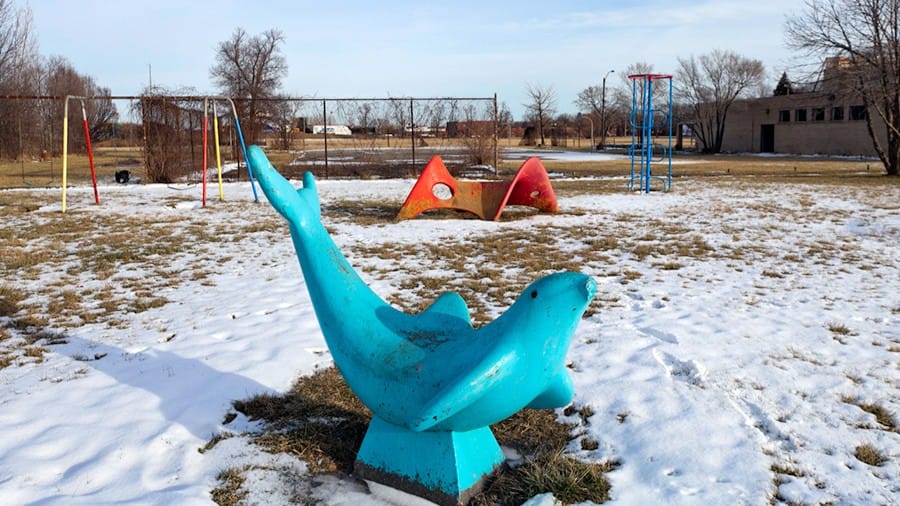
Photo: Scott Hocking
The artist Jim Miller-Melberg might be among the least-known artists whose artworks are among the most well-known, or at least recognizable. That’s because his artworks, specifically his sculptures, are not the kind you’ll find in galleries or museum grounds; instead, they grace the most unlikely places for great sculpture: playgrounds. And they have, by the thousands, since the early 1960s. “Miller-Melberg’s play sculptures strike an emotional chord in those who played on them as children in simpler times. They are simultaneously retro and futuristic. It is impossible not to be happy when being surprised by a Miller-Melberg turtle sighting.” Writes Eric Lorey, whose own interest in and appreciation of the artist and the play sculptures led to a yearlong research sabbatical, thereby creating what can be understood as the definitive account of Jim Miller-Melberg.
Your neighborhood playground, park, or the grounds of a nearby residential community might be the unwitting host to a 50- or even 60-year-old artwork, installed during the national beautification movement of the 1960s, established and led by First Lady Claudia Alta “Lady Bird” Johnson. In what would become a national, concerted effort to improve our public spaces, including our highways, parks, and, importantly, our playgrounds. The origins of this movement can be traced to the end of the Second World War and renewed enthusiasm for public space, leading the government to convene such activities as the “Outdoor Recreation Resource Commission”. The grandness, scope, and urgency of the beautification movement can be understood from a 1967 speech she gave at Yale University, in which Johnson asks and answers, “How can we rebuild the core of our cities? How can we create new towns, pleasant and functional? How can we bring order rather than chaos out of our highway and transit systems? How can we provide parks and open space to let our cities breathe and our people relax? How can we control the waste we put into our air and water? To me, in sum, 'beautification' means our total concern for the physical and human quality of the world we pass on to our children."
The government-led commissions and beautification efforts created opportunities for companies like Form, Inc. and artists like Miller-Melberg to benefit; an estimated 5,000 Turtle sculptures alone were the result. Today, many of those turtles and other play sculptures have been destroyed, unrecognized for what they are, and remain at risk as parks and playgrounds are either updated or fall into disrepair; as Lorey writes, “the pieces are so heavy that many developers simply demolish them.”
How, then, should we understand Miller-Melberg’s legacy and the importance of his play sculptures? A 2016 Fast Company article about Miller-Melberg would have you believe him to be “unsung,” and maybe that applies to his sculptures, too. To me, that’s not the case. Clearly, work is needed to raise the artist’s profile, prestige, and awareness of the play sculptures wherever they reside, within their communities.
Jim Miller-Melberg has a fanbase, with dedicated social media channels and forums. And people like Eric Lorey and Scott Hocking, whose interest and artist practice have merged, with the play sculptures serving as the artist’s muse. He also has a legacy of exhibitions and catalogs. His work and story are included in the exhibition and catalog Michigan Modern: Design that Shaped America, which opened at the Cranbrook Art Museum in 2013 and then at the Grand Rapids Art Museum in 2014. As well as The Art of Play, an exhibition at the Lawrence Technological University’s Center for Design + Technology. The Cranbrook Art Museum’s 2021 exhibition and related catalog, With Eyes Opened, Michigan Modern, With Eyes Opened, and The Art of Play are the most recent exhibitions and related catalogs. No doubt other exhibitions, including earlier ones, have also taken place. Two additional exhibitions referenced in the Michigan Modern catalog were held in the early 1970s at the California Museum of Science and Industry in Los Angeles, now the California Science Center.
How, then, should we understand Miller-Melberg’s legacy? As an unsung artist, or as an art historian, Debbie Millman writes in Michigan Modern that “Miller-Melberg’s sculptural play forms inspired a generation.” While it may be unorthodox to want to celebrate and champion the zoo-themed playground sculptures and period-specific shapes, along with his park tables and seating inlaid with chessboards, benches, and even the elegantly curved, basketball-stand-like structures, it is, however, worthwhile.
On a recent trip, I stopped by the area’s visitor center and asked whether the volunteer knew of a park or playground that had been around for a long time and might have a beloved turtle sculpture. And sure enough, she said yes and told me about a beloved, well-used playground. She wasn’t wrong either, except unbeknownst to her, the older, much-beloved play sculptures had been removed (destroyed, as a local family put it), and the area where their turtle once stood was now covered with a thick layer of dark mulch. Among the family I met, the children were disheartened because each child in the family had played on the turtle, their turtle, including their parents, aunts, and uncles.
It’s easy to understand how these play sculptures became overlooked and unrecognized for what they are: beautiful works of art that reflect a gifted artist and a time period, in both design and materials. The demise of these works, along with changing attitudes about how children are supposed to play and the materials used in play, and the perceived need to create safer, injury-free playgrounds, runs counter to the Miller-Melberg play sculptures. Writer and architecture critic Alexandra Lange writes in her 2018 book, The Design of Childhood, “Children can only understand risk if they are allowed to experience it, whether in the confines of a playground or on the way to it.”
Miller-Melberg understood this. His play sculptures were the antithesis of the jungle gym, calisthenics-inducing equipment marketed to schools and communities. While charming for their simplicity and nostalgic by today’s standards, they are not works of art; rather, they are obstacle courses, conceived as bent pipes and steel plates, exercise equipment posing as climbing structures, swing sets, and the rest. A 1941 catalog from the American Playground Device Company of Anderson, Indiana, introduces its American Castle Tower, “Designed to gratify the child’s inclination to climb—a form of exercise which develops the muscles of legs, arms and backs.” Fast forward to 1975, to Game Time by Toro, whose catalog, now in color, reads as an updated, gimmickier version of its 1940s and 50s predecessors, with splashes of color and quirky names and design.
Miller-Melberg’s play sculptures are not the soft, bouncy, recycled-rubber, accident- and injury-proofed playgrounds befitting today’s spaces, nor the ubiquitous swing set or climbing contraption. Play sculptures are the cement-based structures you stand on, lie under, climb, hang from, and make your own. And unlike much of the playground equipment out there, these are works of art. Strong in design, form, and construction, which is why the play sculptures survive to this day.
The question then isn’t how we should understand Miller-Melberg’s legacy, but what to do about it. Just as a play sculpture is meant to be enjoyed and used, becoming part of the history and memories of generations of children who have played on and loved these sculptures, now is the time to share those stories and raise the profile and knowledge around each sculpture. We must ensure that each has a sign that says, this is a work of art by Jim Miller-Melberg, and you should play on it. If you can do that, go one step further by introducing the context and intent of these sculptures wherever they reside, giving the community an opportunity to draw connections between their own history, art, and play.
Final note: A big thanks to Eric Lorey, whose writing and research made this article possible; Scott Hocking for his knowledge, storytelling, and photography of Jim Miller-Melberg’s play sculptures; and Kat Goffnett at the Cranbrook Art Museum for research assistance.
Should you want to create a sign to accompany your community’s Jim Miller-Melberg play sculpture, consider using this copy:
Jim Miller-Melberg
1929 to 2017, Michigan
Name of the artwork (Turtle, Porpoise, etc.), 1960-1981
Play on it. Love it. Care for it.