
After graduate school, and a great stint in the Harvard Art Museums’ communications office, I joined the staff at the Oakland Museum of California, first as the museum’s marketing manager and later as its audience development manager. It was there that I first met Nina Simon, who was consulting on a project with the museum.
Nina was already widely known for her Museum 2.0 blog, where she wrote about museums, participation, audiences, and the changing field. Soon, she would become even more widely known for her work at the Santa Cruz Museum of Art & History, where she became executive director in 2011. Under her leadership, the museum gained national attention, as did Nina. Her ideas, voice, and writing became an important part of the museum field and continue to influence conversations about museums and their relationship with communities today.
All of which makes Nina’s departure from the museum world—and her turn to writing fiction—all the more interesting.
I caught up with Nina following the release of her second novel, My Sister Is Going to Kill Me.
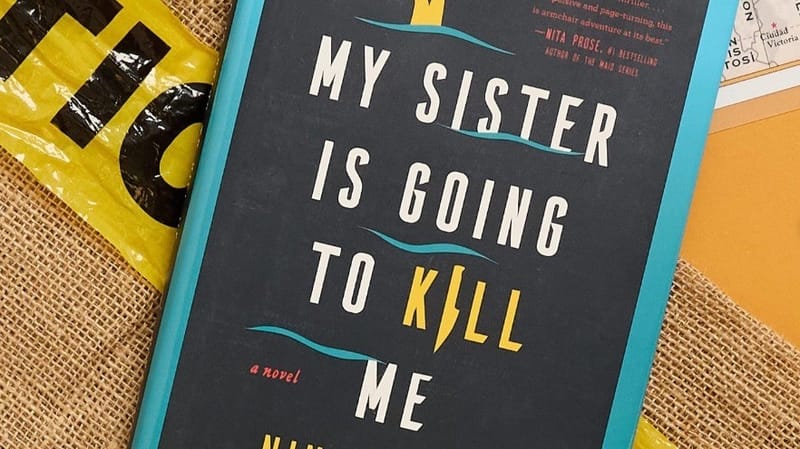
Adam Rozan: Hi, Nina. Congratulations on your new novel, “My Sister is Going to Kill Me,” which comes out this August. It’s not family-friendly, but it’s family-centered? National parks who don it, is that about right?
Nina Simon: That’s right. My Sister is Going to Kill Me is a warm-hearted murder mystery about two mismatched adult sisters, Liv and Mandy, who go on a Grand Canyon whitewater rafting trip and discover a murderer in their midst.
AR: What genre is this, and who’s your audience? I know that sounds like an off-topic question, but as a museum person talking to a former museum person, I also wonder if you still think in terms of audience?
NS: I write crime fiction. My niche is the intersection of strong women, wild places, and dead bodies.
I still think in terms of audience, and it’s interesting to compare how museum people and commercial publishing people use the term. In museums, I was and am a fierce advocate for expanding who might be joyfully engaged and involved in our institutions as participants, members, and audiences. Museums are nonprofits and public entities, and as such, I believe they have a responsibility to make sincere efforts to welcome people from all walks of life.
Commercial fiction publishing is a for-profit business, much closer to the entertainment industry than the nonprofit arts field from which I came. Publishers think a lot about audience, which is great, but they tend to do so in somewhat reductive ways. Most hardcover fiction, in most genres, has the same US audience: affluent middle-aged and older white women. Women out-buy men in almost every category of book, and even a large percentage of books read by men were bought for them by women in their lives.
I love meeting readers—yes, the vast majority women—who feel delighted, transported, and comforted by my novels. I love seeing how the endorsement of a celebrity (Reese Witherspoon selected my first novel for her book club) brings my book to a more age and ethnically-diverse group of readers than the norm.
I love and respect my readers, but I don’t write for them. I write to meet them and connect with them through the most creative, courageous stories I can invent.
In a weird way, this connects me more with my father than with my past work in museums. My dad was an entertainer, and he taught me that the relationship between artist/performer and audience is sacred. I think of him, and that sacred contract, every time I talk with a reader about my work.
AR: And this is your second novel. Your first, “Mother Daughter Murder Night,” published in 2023, was a great success, including a feature in the New York Times. If I understand correctly, it came out of a really challenging situation, your mother’s illness and hospitalization. How is she doing now, and did your mother also serve as a de facto editor for your first novel?
NS: My mom is doing terrific now! I am so lucky and grateful that her stage 5 lung and brain cancer appears to have gone into complete remission.
I wrote my first novel, Mother-Daughter Murder Night, for and with my mom. The entire first draft came together at her bedside. I’d write while she slept, and then, when she woke, I’d slide the laptop over so she could read what I’d written while I made breakfast. We’d spend all day talking about the story and the characters. While she didn’t directly edit the book, she read and commented on every word. My mom is still my first reader.
AR: Can we also talk about museums? For many in the field, it’s likely a surprise to most that you're now a murder mystery writer.
Are you still involved in museums? If not, what led to your transition from museum work to writing?
NS: I’m not involved with museums professionally these days. Very occasionally, I’ll facilitate a board retreat or provide executive coaching to an arts leader driving inclusive change if I think I can offer value. But I rarely say yes. I haven’t worked in museums since 2020, and the world has changed a lot since then. I once wrote a book called The Art of Relevance… and what’s relevant today is different than it was when I was deeply immersed in the field.
My transition from arts nonprofits to writing was abrupt and unexpected. I was director of the Santa Cruz Museum of Art and History (MAH) until 2019, when I left to lead OF/BY/FOR ALL, a global network of museums, libraries, parks, and theaters committed to inclusive community change. I thought that organization, and that founding job, was my pinnacle. I got a vanity license plate for my 2006 Prius with its name. I thought I’d build OF/BY/FOR ALL for a decade. Then, in August of 2020, my mom was diagnosed with stage 5 cancer. She needed emergency brain surgery, chemotherapy, radiation, and who knew what else. It was a wakeup call moment for me. I moved to LA to be with her, switched my focus away from work, and partnered with the OF/BY/FOR ALL board to recruit and support a new CEO.
I never expected to write a novel, but as my mom’s treatment proceeded and my nonprofit work downshifted, I found myself with too much unuseful energy. I decided to pour it into a creative project connected to a shared pleasure for both my mom and me: murder. I never expected Mother-Daughter Murder Night to be published or even considered it while writing the draft. It was just something I did to connect with my mom and find a creative outlet during a tough time. I was surprised to discover how much I loved learning the craft of writing fiction. And I needed more work flexibility to support my mom. So, when I finished the draft, I decided to take the leap, find an agent… and my new professional chapter was born.
AR: What have you learned about pursuing a new career outside your museum work? While challenging, I’m sure it’s also gratifying to discover another side of yourself. Even though you’ve always been a writer, fiction writing is different from your museum books.
NS: I’m a curious person who loves to learn, and I’ve changed industries and roles every 5-10 years to satisfy that joy. I went to college for electrical engineering and got my dream job at NASA when I was 20. When that wasn’t a fit (a quick discovery), I moved into museums, first in exhibition design, and eventually, in leadership and activism. Now, I’m writing crime fiction. My closest friends are already jokingly inquiring as to what might be next.
Writing has always been part of my life, but you’re right—writing nonfiction guides for museum professionals (The Participatory Museum, The Art of Relevance) is very different from writing fiction. Writing those museum books taught me that I could write a full-length book, and even in nonfiction, I found myself trying to learn ways to craft the most engaging story I could. I’m proud of how much more “readable” The Art of Relevance is than The Participatory Museum—it reflects my increasing interest in writing for broad audiences and for readers who open books with pleasure instead of obligation. Writing fiction is a leap, but it’s a leap born from decades building experience, curiosity, and confidence in my writing.
AR: You wore a lot of hats while in the museum field; what are some of your favorites?
NS: My absolute favorites were all at the Santa Cruz Museum of Art and History, which I led through a community-rooted turnaround from 2011-2019, many of which I wrote about in The Art of Relevance and the Museum 2.0 blog.
But there were great moments from the start of my career in 2002, when I was 21 (and fleeing NASA). My first year in museums, I worked at five museums of radically different sizes, disciplines, and audiences. I loved seeing the contrast between what was possible at a huge museum and a tiny one. I did nude art modeling. I created puppet shows about advanced math. I shared an exhibit space with a live goat.
Ultimately, I decided to build the career of my dreams, I wanted to find a mentor. I cared more about who I worked for than what kind of institution it was. I was incredibly lucky (and annoyingly persistent) in 2003 to find Anna Slafer, the head of exhibitions and programs at the then-nascent International Spy Museum. Working at SPY was incredible: large audience, tiny team. Over my three years there, I had so many opportunities to contribute to big projects, especially Operation Spy, a you-be-the-spy big budget escape room for which I was the experience designer. It was during my time at SPY that I also started writing the Museum 2.0 blog, which became the basis for a wide-ranging international consulting career and my eventual leadership of the Santa Cruz Museum of Art and History.
AR: You went from being a museum consultant and writer to ultimately leading the Santa Cruz Museum of Art and History. All these years later, I wonder what takeaways you have from that experience.
NS: Leading the MAH was the single greatest professional experience of my life. I feel certain of this. In most aspects of life, I believe the best is still ahead of me, but when it comes to work, I will never again work with such a special team, and such amazing community partners, to achieve so much together.
My biggest takeaway from the MAH is that more is more. When you commit wholly to a vision, when you bring together people who are obsessed with that vision, when you take risks big and small every day and in every project to pursue that vision… you will achieve things you never, ever could have imagined possible. And you’ll have a ton of fun doing it.
You also won’t have a life outside the work, or not much of one. That was a tradeoff I was willing to make in my 20s and 30s. I’m not willing to make it now.
AR: After Santa Cruz, you started Of/By/For, a museum-based consultancy. What was the goal, and do you think museums have made progress in working with and supporting audiences?
NS: The purpose of OF/BY/FOR ALL was to bring together a network of organizations like the MAH all over the world doing groundbreaking community-engaged work, so we could support each other, provide cross-training to deepen our skills, and inspire change across the communities and industries in which we worked. It was very global, and much both an activist and educational organization.
I can’t speak to whether museums have made progress since 2021 in becoming of, by, and for their local communities. My limited sense is that there was huge enthusiasm for anti-racist and inclusion work across the nonprofit arts that culminated in 2020 with the Black Lives Matter movement. OF/BY/FOR ALL was inundated that year with requests from white-dominant organizations seeking training to involve communities of color. But by 2022, most of that interest had shifted. DEI went from a “must” to a tertiary priority to a hot potato some boards would rather throw out the window. I don’t know where things stand now… which is one of the reasons I don’t feel qualified to participate in the discourse at this time.
That said, I do feel qualified to say that creative instigators are as fired up as ever. I count myself among the artists and activists who feel that art-making is a necessary and life-giving act of resistance against tyranny and oppression. I sincerely hope museum leaders will find the courage to make space and cultivate our collective creative abilities to imagine and create a more just and loving world.
AR: Returning to your writing, how do you use museums now, and are they part of your writing, research, or even your social life with other writers, editors, or publishers?
NS: I visit museums rarely—perhaps a couple times a year. I still absolutely love to be in the presence of art that moves me. And it’s a treat when I can visit a museum where I once consulted or worked and revisit the “old friends” on the walls that inspire me anew and connect me to my past lives.
My agent would love for me to write a museum-based murder mystery or heist story; it’s a very popular trope. Maybe someday I will. But for now, I’m finding great pleasure setting my novels in the wild outdoors. For me, there is no human-made art that rivals nature. Fortunately, we live in a world of cooperation, not just competition, and I feel grateful to experience both.
AR: Last question, what was your first museum experience?
NS: Space-themed day camp at the California Museum of Science and Industry in Los Angeles (now the California Science Center). I was completely obsessed. That obsession made me certain I’d build a career at NASA. I am so grateful that life has had much, much more in store for me than I could have ever imagined in that museum at age 8.