
At some point over the past few years, I stumbled upon a red vending machine selling the most fabulous mini prints by the artist Ana Inciardi. For just four quarters, you can own an artwork and help Ana make art accessible to everyone. In a short period of time, I also became a big fan. I’m not alone. Search Ana’s name, or, if you dare, explore the world of Ana Inciardi on Facebook, Instagram, Reddit, and TikTok, and you’ll find a vast universe of super fans, collectors, and all the conversations that go with it.
This past Summer, when it came time to plan Civic Season 26 (Juneteenth to July 4) at the Smithsonian’s National Museum of American History, I knew we needed to work with Ana. Civic Season just celebrated its sixth season, bringing together hundreds of organizations and tens of thousands of people to explore our nation’s history, share their wishes for its future, take action to help shape it, connect with their communities and neighbors, and participate in civic life through museums, volunteering, public programs, community conversations, and countless other activities.
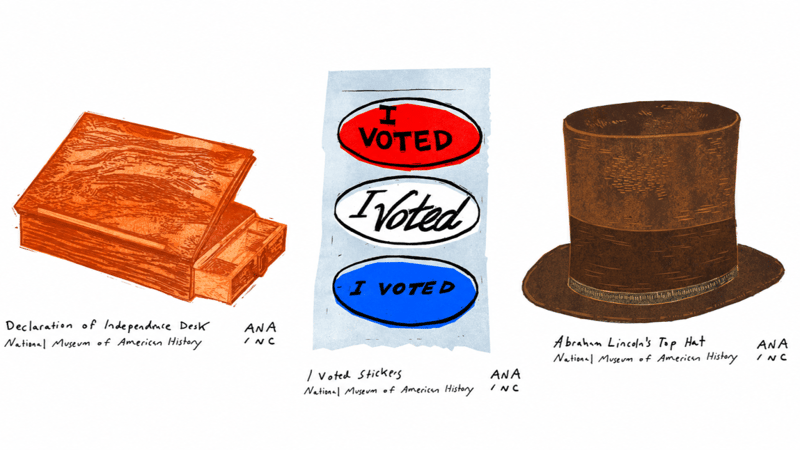
Working with Ana and colleagues across the museum, we chose five objects that resonate with the spirit and aspirations of Civic Season and reflect the activities that take place during the Season and year-round. While each would make a great print, we worked with Ana to create e-prints to promote museum and library programs, community events, and activities that uplift our neighborhoods.
I caught up with Ana to discuss this year’s Civic Season, her e-prints, and her plans for the Season.
Adam Rozan: Hi, Ana. Can you introduce yourself and share what you do?
Ana Inciardi: Hi! I'm Ana Inciardi, a relief printmaker originally from Brooklyn, New York, now based in Portland, Maine.
AR: For those reading this who don’t know your work and might be unfamiliar with your vending machines, can you describe your art and how you get it out there?
AC: Food has always inspired my art; it connects me to the people I love the most! Dinners with friends, my family’s recipes, and of course my wife, Addison, who is an organic vegetable farmer (and founder of Feastland Farm), are where I draw the most inspiration.
In 2020, I was selling my art at markets here in Portland and was looking for a way to draw folks into my booth. Around the same time, we were experiencing a quarter shortage, and our only way to do laundry in our apartment was to go to a local coin-op laundromat. The mini-print vending machine idea was born!
It worked, and I was able to do our laundry (much needed with all our ink- and dirt-stained clothes). Eventually, we started partnering with local businesses, and the rest is history.
AR: Before we talk about your e-prints, can we talk about Civic Season? What’s Civic Season to you?
AC: I learned about Civic Season through this partnership with the Smithsonian. This year, being the 250th, it seemed like a perfect opportunity to create art with civic action organizations and historic institutions.
AR: For Civic Season at the Smithsonian’s National Museum of American History, we worked with you to create five prints, different from how you typically work. Instead of prints being sold (for now) at a location, we’re offering e-prints, available as downloadable PNG files, for people to use when promoting their community events and programs.
What was important to you about this?
AC: This partnership is different from any I’ve done before. I’ve enjoyed the challenge of creating something outside my usual subject matter. It’s been interesting to see how folks interact with and interpret the art for their purposes, and having these prints available to anyone with just a click aligns with keeping my work as accessible as possible.
AR: Civic Season is all about making a difference. Taking action. Doing something. Volunteering. Participating. Making your community better. What’s one of your Civic Season activities that you’re doing?
AC: Here in Portland, my wife and I take action within our community by offering CSA shares to people who otherwise might not be able to afford it. Having access to fresh produce is so important and should be something everyone can enjoy. I’ve also partnered with Maine Needs to support our unhoused neighbors. Working with them has been so rewarding. In a full-circle moment, the quarters that go into our machine at their location go to folks who need assistance with laundry!
AR: You’ve worked with some wonderful art museums across the country, and to the best of my knowledge, this is your first time working with a history museum. What was important to you when you were creating prints for the objects we ultimately chose?
AC: Accuracy is always important; sometimes my art is the first experience someone will have with an object, so I want to make sure it’s represented well. It was also important to me that we represent multiple perspectives of American history through the prints we created. So, we have a couple of founding fathers, as well as women’s suffrage and the civil rights movement.
We also have a machine at the Greenwich Historical Society!
AR: Together, we chose five objects. What are they, and why those five?
AC: We landed on Abraham Lincoln’s Top Hat, Jefferson’s Desk, the Greensboro Lunch Counter, Alice Paul’s Jailed for Freedom Pin, and the “I Voted” Stickers.
AR: What did you learn about those objects and those histories from creating the prints?
AC: So much! I learned that top hats were made with beaver pelts and Jefferson’s Desk was a travel desk (remote work ahead of its time). I had never heard of Alice Paul and her work for suffrage, but learning her story, specifically what led to her being awarded this pin, was amazing.
AR: I should clarify that the I Voted print is 100% your artwork, based on objects in the museum's collection. Can you tell me about your I Voted sticker and your design?
AC: The sticker design is so iconic, so I wanted to keep the recognizable shape. The bold colors and “chatter” from carving definitely brings in my style.
AR: We talked earlier about the goals for these prints to be shared and used by community groups and individuals for public-facing programs at farmers’ markets, libraries, museums, etc. What would you like to see happen with these e-prints, and how would you like for them to be used?
AC: I’d also love to bring my voting stickers to life and have them distributed at voting centers. As a frequenter of farmer’s markets, I’d love to be handed a flyer with one of these images on it or pass by a local library with one of these images on a poster for an event.
AR: Last question. What’s your wish for the future of the U.S.? If you could, think about 5, 10, and 50 years into the future.
AC: My wish is always for more access, more equality, and more opportunity for all Americans. I think about my family in Brooklyn, and feel very proud and lucky that we landed there. New York is such an inspiring place and I think it represents hope for the future of our country. I hope everyone gets to experience the community of a neighborhood like the one I grew up in, plus the food is sooooo good. I hope everyone gets amazing public transit! I hope everyone is able to pursue their joy.